
Group
Nordling
A Nordling is an inhabitant of the Northern Kingdoms on the Continent…
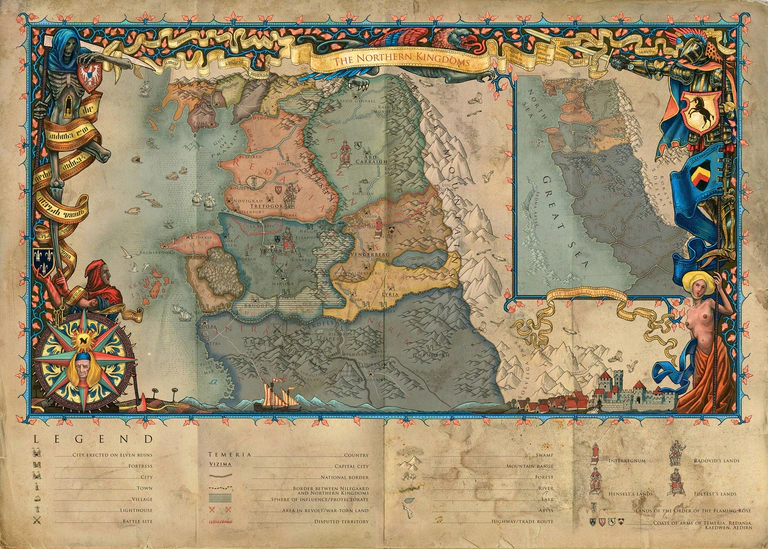
A Nordling is an inhabitant of the Northern Kingdoms on the Continent, belonging to human cultures dominant in those realms. It is a colloquialism often applied to Northerners by Nilfgaardians from the southern regions of the Empire, and by the Ofiri, but rarely used by the populace of the North themselves.
History
The ancestors of Nordlings came to the Continent during the Landings, beginning with the Landing of the Exiles around the 760s. Though relatively small in number at the beginning, thanks to their military art and fertility they managed to conquer the land belonging to the Elder Races in a few centuries. At the height of their range, Nordlings had states from the Kestrel and Dragon Mountains in the north to possibly even Ebbing in the south – the southernmost known area where the Common Speech is the main language.
Their might began to vanish in the 13th century, when the armies of the Nilfgaardian Empire started the so-called Northern Wars, ultimately conquering almost every land south of the Yaruga.
At the time when Encyclopaedia Maxima Mundi is written, several centuries after the Northern Wars, the Common Speech is considered an endangered or even dead language, though some realms like Cidaris are still referred to as the "Northern Kingdoms".
Physical description
Being a mix-up of several waves of settlers and native nonhuman societies, Nordlings can have various physical traits. They are tall and short, skinny and muscular, slim and stocky. Their hair color varies as well: black, blond, brown and red occurring most often. People of elven heritage sometimes have more unique hair or eye color, e.g. ashen or purple. Nordling skin color is described either as are pale or swarthy, depending on the location. Seaside cities seem to have a more diverse population, likely due to contacts with the Empire and oversea countries.

Social structure
Nordlings live in a feudal society and their lands are shredded between several kings and dukes. They are mostly agricultural society, running several farmlands providing food for cities and the nobility. Folks living near the sea or rivers often deal with fishing or aquaculture. Industry is less important, and is often left to mages, like those of Rissberg, or assimilated nonhumans, most often gnomes and dwarves.
Weapon laws
Most Nordlings own and bear weapons. Even in some capital cities people bear arms, to the extent that "everyone in Vizima bears a weapon" can be said. People bring weapons even during cultural events, and those who cannot afford buying proper arms, like peasants, use scythes, kitchen knives and other dangerous tools. Exceptions can be found, like in the case of Kerack, where entering the Upper City is permitted only after leaving your weapons in the guardhouse.
Discrimination
In contrast to the Nilfgaardians or Aen Elle, Nordlings do not practice slavery. Unfortunately, in several lands the situation of peasants or nonhumans is often not an enviable as they are forced to deal with everyday classism or xenophobia, as well as strict rules, giving them lesser rights than upper classes. For example, only the pureblood nobility can enter cities during the nights, while commoners or people of even a small percentage of nonhuman genes are dissallowed.

Racial tensions sometimes grow so high they culminate in mass-pogroms. Among the human groups themselves the racism seems to be rare, with an exception in case of the Rivians living outside of their land who are mockingly referred to as "Rivs" and widely perceived as robbers and thugs. In 1252, Geralt of Rivia was mistakenly recognized as a Rivian and attacked by Vizimans in The Fox.
Witchers are the outcasts of the society; perceived as unholy mutants, not so better than the monsters they fight, these warlocks often face mistrust and hostility from people they protect.
Mages and clergy
Mages generally sit in high positions in Nordling society. Members of the Brotherhood, whether masters or practicing dwimveandras, are warmly welcome both in rural areas and metropolises. The most renowned sorcerers and sorceresses serve as advisors to monarchs. Many cities and towns have their own resident mages who live in towers providing magic assistance and selling magical items. Anti-magic sentiments arise rarely, the most famed and bloody being the witch hunts lasting from 1272 to 1276.
Another privileged group is the clergy. Several cults, differing in rules and commandments, arose around the vast pantheon of deities and divine powers, and priests and priestesses are often respected members of the society, whether as isolated monks and reverends in small rural parishes, or archpriests and hierarchs in vast metropolises. Druids, somehow in between priests and mages, are important as well, though regarded as more mysterious and quite anachronistic. They often take care of ecological issues such as overfishing or forest clearing.
Women's rights and sexual minorities
The situation of women's role in society varies throughout the realms. There are several successful warrioresses, priestesses or sorceresses, but there are as well many cases when a young maiden is forced by the family to marry an unwanted person (to do justice though, several young men are forced as well). While the decision to abort is for the most part considered as an indefeasible right, Belohun had tried to force through anti-abortion rights in Kerack, but his advisor sorceress Lytta Neyd convinced him to change his mind.
The Nordlings seem to be rather liberal in views on non-heterosexual relationships since bi- or homosexual affairs are popular and perceived as normal among the mages. Exceptions however exist, and at least a number of people perceive non-heterosexual couples as "perverted".
Language and writing systems
Based on the languages of the various groups of colonists and nonhumans, Nordlings developed their own tongue, called the Common Speech or Common Tongue. It consists of a couple of dialects and so people from the different parts of the Northern lands are often easily recognized because of their accent.
Two writing systems are in use, First Runes and the modern alphabet.
Education
In most of the Nordling lands, education is a domain of the upper classes – it's hard to attend university unless one has wealthy or influential family. This isn't the case when it comes to the academies of magic or temple schools, which provide knowledge for everyone with talent and willingness.
One of the known exceptions is a program of state education started by Griffin of Temeria, who founded the chain of free three-year elementary schools called "griffinettes".
Art
Their paintings are often mentioned as respected art. Rulers often have their own court painters, and galleries of paintings can be found in universities, magical academies, temples, and other places.
Arts like music, poetry, and storytelling are the domain of bards, sometimes called minstrels or troubadours; wayfaring men and women who make a living from singing tales, whether on noble courts or during rural festivals. An annual tournament of troubadours is held in Castle Vartburg each autumn.
Religion
Nordlings believe in and follow a vast amount of deities they call "Immortal Ones", divine powers, popular prophets, saints and heroes, as well as several minor powers or idols like the sacred unicorn, worshipped by country dwellers from the Unicorn village. They are polytheistic, but the temples are devoted only to the certain beings.
Sources
Adapted from the original article, under CC BY-SA 3.0.