
Group
Ducal house of Toussaint
The ducal house, as they are generally known, is the current reigning family in…
In vino veritas.
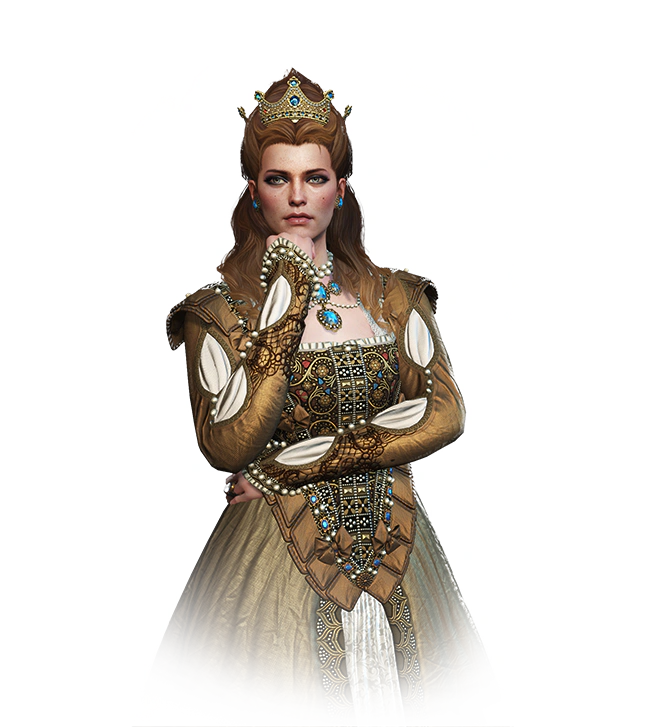
The ducal house, as they are generally known, is the current reigning family in Toussaint. Since ca. 1160s until at least 1275, all rulers from the house were women. Still, the male consorts also get to be addressed as dukes proper, as was the case with the husband of Duchess Anna Henrietta, Duke Raymund, prior to his death in 1265. From the reign of Duchess Adela Marta onward, the family has had its residence in the Beauclair Palace, overlooking the town of Beauclair.
Although bordering Nilfgaardian provinces and really dependant on the empire, the Toussaintois monarchs are recognized as sovereign. The Nilfgaardian Army respects the borders of their demesne and no secret service sends agents to spy on them. The ducal house was in fact related to one of the imperial dynasties, the Emreis family.
Style and regalia
Locally styled the ducs and the duquessas, the ruling heads of the ducal house take great care to upkeep protocol and tradition. Indeed, traditions themselves are considered sacred. The current full title of the Toussaintois monarchs is "Her/His Enlightenment the Duchess/Duke of Toussaint and Lady/Lord of Beauclair", first adopted by the Duchess Adela Marta after she had Peter Faramond refashion the old elven Beauclair Palace into a proper ducal residence.
As for the correct way to address the ruler, Sebastian Le Goff, Chamberlain and Marshal of the Court to the Duchess Anna Henrietta, once instructed the witcher Geralt of Rivia that the official protocol dictated to always refer to "Her Enlightened Ladyship". Unofficial variant preferred by Anna Henrietta herself was "Her Grace", but in more casual matters outside the court he saw it as permissible to simply talk about "Lady Duchess." A more elaborate alternative to "Her Grace" was "Her Gracious Magnificence", or, used at least since the times of Duke Henri III, "Her/His Illustrious Grace".
One particular heirloom symbolic to them was a large green gemstone called the Heart of Toussaint. It had been given to young Sylvia Anna prior to her exile, by which point it had been in the family for generations. The house blazon features a golden sprig of grapevine on a green field. Originally, its crest had been decorated by a helmet. When over several generations the rule came down exclusively through duchesses, the helmet had been replaced by a ducal crown.
A Duchy Ascendant
Not long after the Landing of the Outcasts, in 781–782, the Aen Seidhe realm of Dol Naev'de led by Divethaf fell prey to Ludovic, an ambitious Outcast and first local king. It is unknown how King Ludovic is related to the later ducal house, or if at all. The wars with the elves themselves, mixed with periods of attempted coexistence, ended only in ca. 1060s. In those times, the noble Toricellas conquered for humans the last holdings of what would eventually become Toussaint.

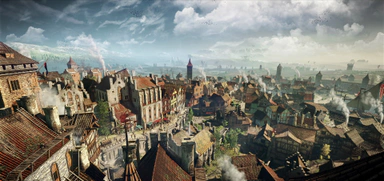
The earliest point to which the current ruling family can safely be dated is the first half of the 12th century, considering that around the 1160s, the ducal coronet is noted to have began passing down exclusively in its female line. Not long after, the Duchess Adela Marta had comissioned Peter Faramond to not only rebuild the abandoned elven Palace of Beauclair into a magnificent seat of power, but also to lay out the city plan of the town of Beauclair below. Routine runing of the city is entrusted to the Beauclair Magistrate. Unsatisfied with marriage offers from men who did not exhibit her preferred attributes (strength, valor and intelligence), Duchess Adela Marta sanctioned the first grand chivalric tourney. In the end, she married the youngest son of the Nilfgaardian Emperor whom she met on a journey south. The tourney, however, had been such a success that it became an annual attraction.
Known for declaring that peace could be secured with "wine, wine, and more wine", the Duchess not only granted Castel Ravello its ducal vineyard privileges, but also dedicated a part of the palace cellars to their famous white wine Est Est to ensure her house always had a steady supply. This she followed almost immediately by an edict Vino Sanctus Est, barring any unauthorized pouring from said ducal barrels on a pain of death — in her time, local viticulture rose to both sacred duty and grand policy. At one point or another, Castel Ravello would also begin to make Sangreal, a mark of red wine reserved exclusively for the tables of the ducal family.
The Duchess' name is borne by the Ademarta Order, awarded to liegepersons for exceptional feats of bravery. Despite being the Ladies of Beauclair both in name and in deed, not all secrets of the ducal palace had been made apparent to the duchesses or their chamberlains, not even to the first Lady Adela Marta. At least one corridor leading to a secret chamber, disguised by a powerful illusion, had been known only to its original inhabitants, the elves, and later to few mages linked to the ducal house. These eventually included Artorius Vigo and his niece Fringilla Vigo, both well-versed in illusions.
Saints, Mages, and Druids
Succeeding the energetic Duchess Adela Marta, her descendant Carolina Roberta continued to enhance the palace, adding the Caroberta Tower. Finding picking teeth with one's knife uncouth, this Duchess introduced knives with a rounded ended in the Beauclair Palace. In her days, a man named Plegmund came to the duchy spreading wisdoms of the Saint Prophet Lebioda, soon gaining the reputation of a saint. Attaining trust of the rich and the poor alike, he had managed to get into the good graces of the Duchess herself, with Carolina Roberta supporting his idea to build temples in Beauclair and along the Sansretour River.

Not much is known about the Duke and the Duchess who took over in the first third of the 13th century. At this point, one of the trusted sorcerers of the ducal family had been the illusions master Artorius Vigo. Another one of the Duke's advisors was the knight errant Ramon du Lac. Indeed, Sir du Lac was so close to the Duke that the sovereign trusted the friends of this knight as well. Indeed, Sir du Lac, as well as the rest of his knight team, that is Count Vladimir Crespi, Count Louis de la Croix and Baron Milton de Peyrac-Peyran, all had confidance of the Duke and the sovereign would ocassionally turn to them with delicate matters.
To entertain the daughters of the ruling couple, Sylvia Anna and Anna Henrietta, Vigo created a complex illusion of a fairytale land. As the former had been born under the full eclipse, rumors of her being affected by the so-called curse of the Black Sun made the Duchess and the Duke uneasy. The ducal couple had her examined by the Chapter of the Gift and the Art, and although the mages did not find her to be a threat then, it had later been surmised that the court would be safer with Sylvia Anna exiled. The aforementioned group of knights errant had been ordered to escort her to the edge of the Angrenian Caed Dhu, which order they fulfilled.
At another point later, the couple had organized a chivalric tourney during which they hired the bard Dandelion to compose a ballad praising the knightly valor on display. Dandelion had instead composed a love song aimed indirectly at the heiress Anna Henrietta, at that time already betrothed to Raymund. The poem had delighted Anna Henrietta but her father, the outraged Duke had refused to pay the poet.
By 1258, the ducal coronet was inherited by the Duchess Anna Henrietta, through which fact her husband Raymund became the Duke. Though unfaithful to each other—the Duchess had an affair with Dandelion, while the Duke openly kept up with several mistresses, with at least one as far as Cintra—the two remained a pair until 1265, when the Duke died after a second appoplexy attack in past year. Although an official period of mourning did take place, many Beauclairois breathed a sigh of relief, considering him a "good-for-nothing rogue and whoreson". In contrast, most inhabitants of the duchy sincerely adored the Duchess. By then, the house had amassed the largest private library in both the Northern Kingdoms and the Nilfgaardian Empire, with glass roof providing all of it with sunlight. Moreover, as the family oriented itself towards neutrality, they had by that point stopped mustering armies to take sides in outside wars. Instead, they had entrusted internal order and security to their guard and a host of loyal knights errant compensated monthly for their virtuous deeds by the ducal treasury.
The ducal house deeply understood that its wealth stemmed from exporting wine, after all, many of its members themselves greatly enjoyed the produce of local vineyards. Still, they were also long fond of the wild, unspoiled woods in their demesne. In one part of the duchy's wilderness, the Duchess Carolina Roberta delighted in elaborate games of hide and seek, so the forest came to be known as the Caroberta Woods. In 1267, this contributed to the decision of the Duchess Anna Henrietta to set down a series of compacts with the immigrant druids of Caed Dhu. Through said compacts, the Duchess had given much of Caed Myrkvid to the druids as an involiable sanctuary, where even the knights errant may not freely enter. When the druids got into a dispute with the influential Coopers' Guild poised to claim freedom in harvesting oak for wine barrels, the ducal house had mediated an accord. The guild would be allowed to take regulated amounts under druidic supervision, while the druids were to cultivate, collect and deliver useful plants to the ducal house.
Members
Female
Consorts
Relation uncertain
Adela Marta ("Ademarta")
Carolina Roberta ("Caroberta")
Anna Henrietta ("Anarietta")
Sylvia Anna ("Syanna")
A Nilfgaardian prince
Roger
Notturna
Sources
Adapted from the original article, under CC BY-SA 3.0.